In an era where computational tools are transforming mathematics education, Wolfram Media’s latest release, Essentials of Complex Analysis: A Computational Approach by Marco Saragnese (published December 16, 2025), stands out as a fresh, interactive introduction to one of the most elegant branches of mathematics.
Complex analysis, with its profound theorems like Cauchy’s integral formula and the residue theorem, has traditionally been taught through rigorous proofs and abstract theory. While classics like Ahlfors remain gold standards for depth, they can feel dense for undergraduates. Saragnese, a kernel developer at Wolfram Research specializing in symbolic integration, takes a different path: blending classical theory with hands-on computation using the Wolfram Language (the power behind Mathematica).
Why a Computational Approach Matters
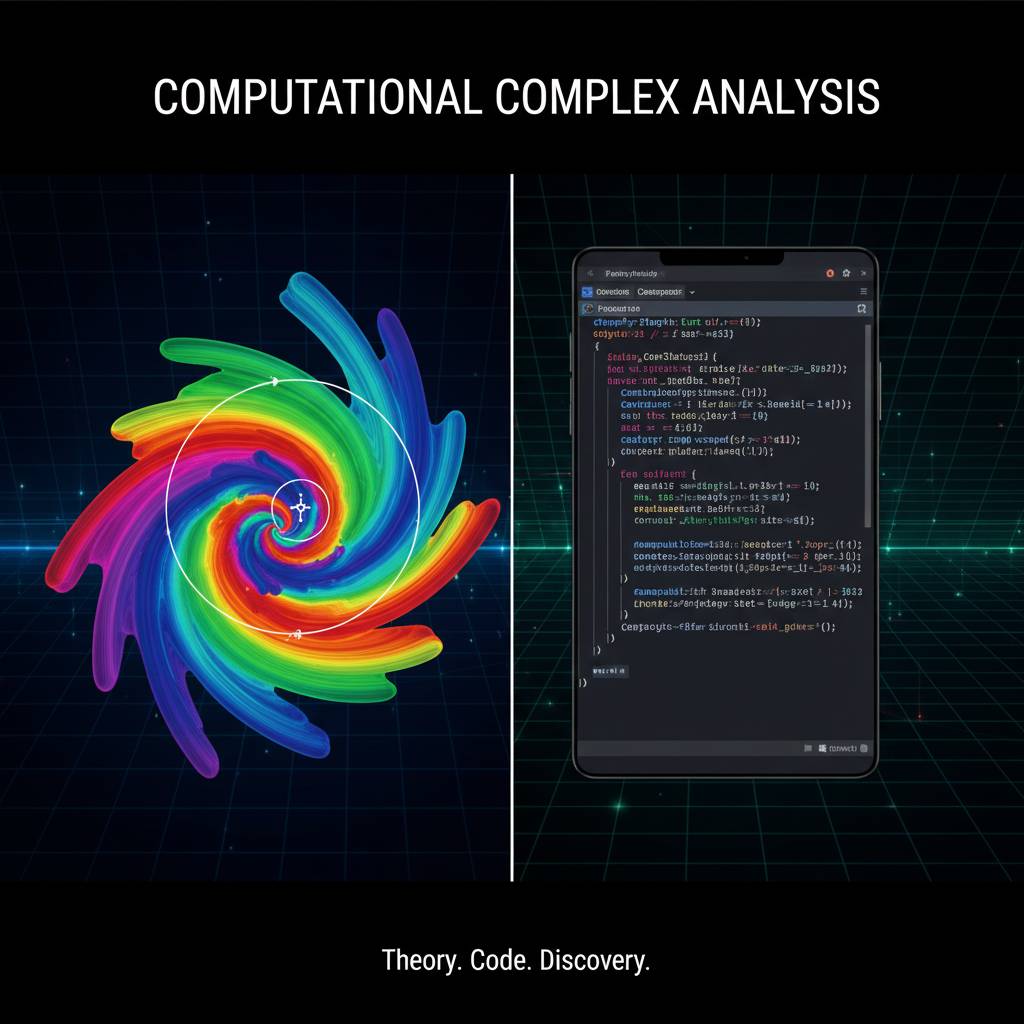
Complex analysis is inherently visual and geometric—think domain coloring, contour integrals, and conformal mappings. Yet many textbooks rely on static diagrams and pen-and-paper calculations. This book flips the script by providing interactive Wolfram Notebooks that let students manipulate live code, plot functions in the complex plane, and experiment in real time.
Key highlights:
- Free downloadable interactive ebook version with executable Wolfram Language code.
- Notebooks runnable in full Mathematica or the free Wolfram Player.
- Companion Wolfram U course with videos, interactive demos, quizzes, and exams.
This makes abstract concepts tangible: visualize the exponential function wrapping the plane, explore branch cuts in the logarithm, or compute residues numerically and symbolically.
Core Content: From Basics to Applications
Aimed at undergraduates in their first complex analysis course, the book covers all essentials without overwhelming prerequisites:
- Complex plane, functions, exponential, logarithm, and powers
- Limits, continuity, derivatives, and Cauchy-Riemann equations
- Complex integration, Cauchy’s theorem, and integral formula
- Power series (Taylor and Laurent), residues, and the residue theorem
- Harmonic functions, holomorphic/meromorphic classification
It wraps up with practical applications:
- Transcendental equations and definite integrals
- Gamma function and Laplace transforms
- Hydrodynamics and elliptic functions
Each chapter includes exercises with full solutions, plus a comprehensive review section and sample final exam.
Who Should Read This?
- Undergraduate math/physics/engineering students seeking an intuitive entry point.
- Instructors wanting modern, interactive materials—perfect for flipped classrooms or hybrid teaching.
- Self-learners with access to Wolfram tools (free Player makes it accessible).
If you’ve used older computational texts like William T. Shaw’s Complex Analysis with MATHEMATICA® (2006), this feels like a spiritual successor: updated for modern Wolfram Language, focused on core undergraduate topics, and tightly integrated with interactive notebooks.
Final Thoughts
As computational mathematics gains traction—evident in tools like Wolfram Alpha and Jupyter notebooks—this book arrives at the perfect time. It doesn’t replace proof-heavy tomes but complements them by making complex analysis explorable. For a generation of students comfortable with coding and visualization, Saragnese’s approach could make theorems feel like discoveries rather than memorization.
Available in paperback, Kindle, and Wolfram Notebook formats from Wolfram Media. If you’re teaching or learning complex analysis in 2026, this deserves a spot on your syllabus—or desktop.
Learn more and purchase at the Wolfram Media Store.
Follow us for more Updates